Schools face mounting cybersecurity threats, and IT teams need solutions that protect every student and staff login without adding complexity. In this session, thought leaders and district practitioners unpack the realities of identity-based threats in K-12 — and what it takes to stay ahead of them. ClassLink's security experts then demonstrate how ThreatScan and Security Center provide real-time threat detection, compromised credential monitoring, and centralized control in one intuitive platform. Hear directly from a district that has put these tools to work and the measurable difference it has made for their team.
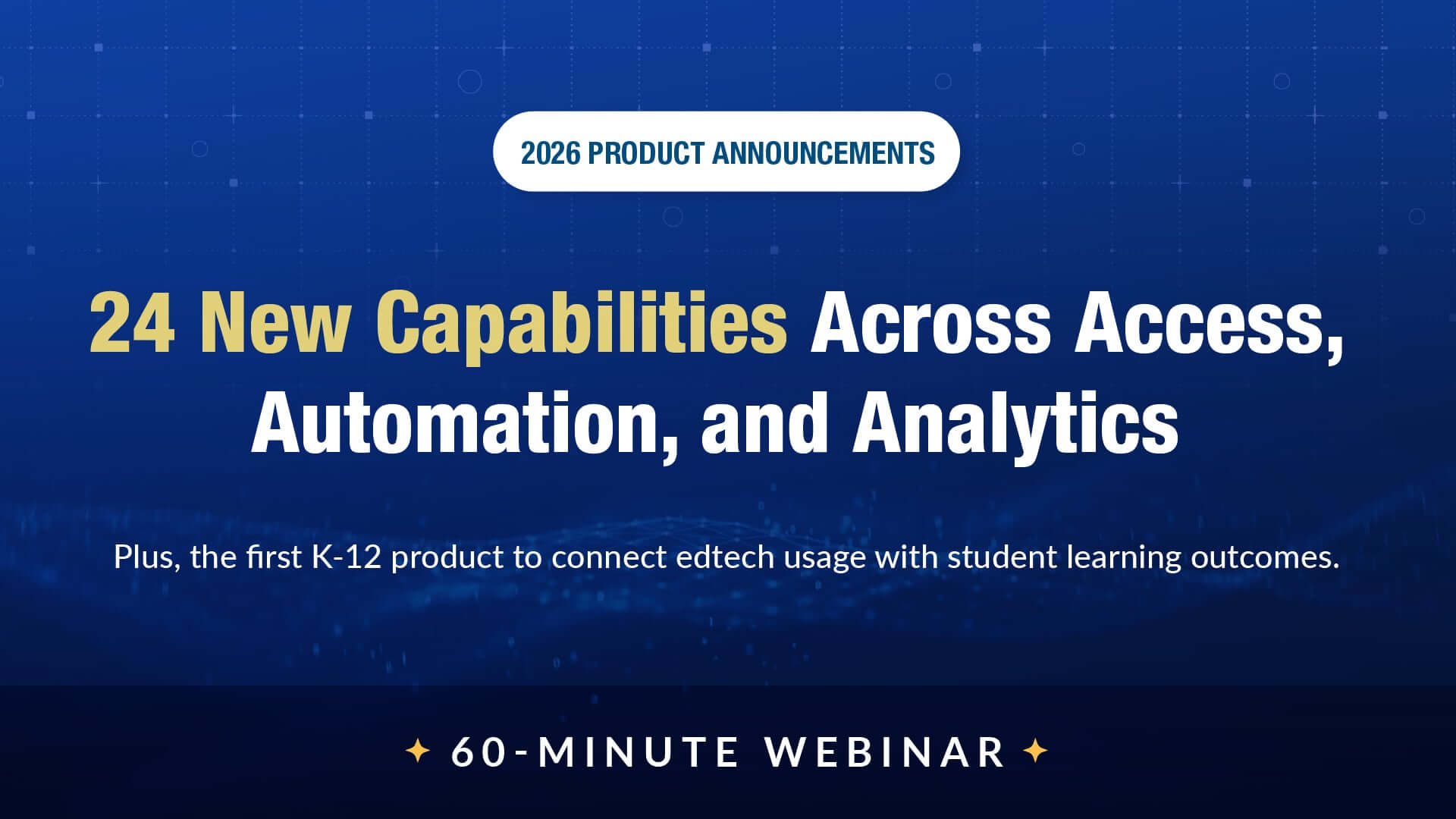
The ClassLink team reviewed 150+ district strategic plans and found three consistent priorities. Every person must have what they need. Every process must securely run itself. Every dollar must prove its worth. See 24 new capabilities across Access, Automation, and Analytics, and learn how to measure which edtech tools actually improve student scores.
ClassLink just redefined what’s possible for school cybersecurity and data management, unveiling three powerful new solutions—ThreatScan, AppTrack, and OneData—alongside more than a dozen new product features and upgrades now available at no additional cost to schools.
Join E-Rate expert Michael Flood, and the team at ClassLink for a webinar that will empower you to navigate the FCC Cybersecurity Pilot Program (CPP) application process with confidence. Gain exclusive access to an application guide for gathering critical information. Discover why 2800+ school districts trust ClassLink's cost-effective Identity and Access Management (IAM) solution as a key part of their cybersecurity efforts. Learn more about what makes ClassLink an eligible service provider under Category 3 of the CPP. Join this webinar to learn how to include this critical category in your cybersecurity planning and begin preparing your Form 484 Part One application.
Data standards increase transparency and streamline analysis by ensuring a common language across systems. In this session, we will explore the "what" and "why" of data standards. Join industry experts as they discuss the future of data standards, the need for standards that address usage analytics, and how educational data standards enable learning analytics.
Schools and their vendor partners have long struggled with solutions to protect shared PII data—until now. ClassLink DataGuard offers a revolutionary approach to limiting the amount of sensitive data shared, ultimately reducing risks for schools and vendors. It's a win-win for both parties and the entire industry. DataGuard allows schools to replace key PII fields with meaningless letter scrambles before sending data to a vendor. Don't let rostering protocols compromise your school's data security! Join this session and learn how to minimize the risks associated with data sharing and protect your schools against cybercriminals.
The launch of artificial intelligence tools like ChatGPT have increased awareness for K12 classroom and district leaders. The topic of many water cooler and school board conversations, AI language models and chatbots have created a revolutionary moment in the world of education. In this webinar we’ll cover what our role as edtech leaders is in a district’s approach to generative AI and how to increase understanding around AI while decreasing disruptions to K12 lessons and curriculums. We’ll also discuss what the future might hold for AI and K12, disruptive IT analogs we can relate to, and derivative works and curriculums.
MTSS teams have the important responsibility of collecting, connecting, and analyzing vast amounts of data that inform decision-making to ensure all students are supported efficiently and effectively. The problem is that data often “lives” in different systems and formats, which can make it difficult for educators to develop a comprehensive view of student needs, growth, and overall success. So how do we ensure that the appropriate data are identified, aggregated, and exchanged so we can DO something with it? Enter Data Interoperability! In this webinar, we’ll explore what data interoperability is and why it’s critical to your MTSS practice. We’ll also use Branching Minds and ClassLink as examples of how data interoperability looks and how it can help streamline your MTSS practice, enhance collaboration, improve outcomes, and ensure equity.
The launch of artificial intelligence tools like ChatGPT have increased awareness for K12 classroom and district leaders. The topic of many water cooler and school board conversations, AI language models and chatbots have created a revolutionary moment in the world of education. In this webinar we’ll cover what our role as edtech leaders is in a district’s approach to generative AI and how to increase understanding around AI while decreasing disruptions to K12 lessons and curriculums.
Join us for a groundbreaking new initiative to support schools on their journey toward becoming cyber-secure. ClassLink and ENA have teamed up to create a coalition of ed-focused organizations dedicated to this cause. Introducing the Cybersecurity Rubric (CR) for education, an easy-to-use tool informed by NIST and other relevant cybersecurity and privacy frameworks. Say goodbye to the complexities of past standards and frameworks! Instead, this tool will help K-12 practitioners to self-assess their cybersecurity environment and be used for continuous improvement. Attend this webinar to gain exclusive access to the rubric, training, and a waived exam fee to become a CCRE (Certified Cybersecurity Rubric Evaluator).
Today, technology procurement is more complex and involves more stakeholders than ever before. Working closely together, purchasing teams and technology teams must determine which products and services offer safe and secure systems at the best price and value while meeting compliance regulations and purchasing guidelines. Join this webinar to learn how technology teams can work with purchasing teams to better understand their role in the RFP process and how we may develop strategies to design more comprehensive RFPs. In this webinar, you’ll learn about using data privacy agreements to mitigate risk and manage data, examining how Technology and Purchasing teams can work together to meet the objectives of a project, and inspecting key processes to ensure technologies being purchased follow compliance, security, best value, and regulations.
In the third installment of this series, Amy McLaughlin (CoSN) discusses the key technologies for protecting schools and data, the limitations of technologies as an essential safety net, Multi-Factor Authentication (MFA) and Backup and recovery.
In the second installment of this series, Amy McLaughlin (CoSN) discusses the cybersecurity challenges facing K-12 school districts today. In this webinar, you’ll learn how to take a systematic approach to your cybersecurity in addition to how to design and build security policies into your district’s processes and procedures.
Cyberattacks against K-12 schools are a serious and ever changing threat—and they’re on the rise. In this webinar, Amy McLaughlin (CoSN) discusses the most common threats to school districts, provides proactive steps districts can take to protect their systems and data, and shares resources to empower school districts against cybersecurity threats.
The U.S. Department of Education's Digital Equity Education Roundtables (DEER) initiative seeks to close the digital divide and enable all learners in PK-12, higher education, and adult education to unlock technology-enabled opportunities and fully participate in a digital society. In this session, the Office of Educational Technology (OET) will share key takeaways from the DEER Initiative and how these lessons may help leaders build effective digital equity plans under the Bipartisan Infrastructure Law (BIL). OET will also discuss role of different sectors in the digital equity ecosystem, including local leaders, in supporting digital inclusion efforts for learners, families/caregivers, and communities.
Usage data is critical to understanding whether equitable digital learning occurs in your district for all students. Analytics can illuminate the digital engagement of students and provide insight on everything from equitable access, to return on investments and professional development needs. Combining analytics with best practices to evaluate learning applications will help you streamline and improve the quality of your EdTech ecosystem. In this webinar, ClassLink will: share an analysis of the top applications used in our client districts and what differences exist in the types of apps used in schools based on characteristics, highlight ClassLink Analytics' reports that help districts analyze which applications students use and the differences in applications across school buildings and groups, and share best practices for selecting and evaluating applications.
Ransomware attacks on district data are on the rise, making data security a critical concern. ClassLink’s privacy and security features don’t just keep your data safe—they also help you establish transparency and build trust around data security. Join us to learn how ClassLink helps protect your data and also provides a public-facing inventory of digital resources used in your district so everyone can understand your data security efforts.
Equity and access are complicated problems that require an ecosystem of supports. Learn how ClassLink fits into that ecosystem with analytics and a unique approach to rostering to help you measure, understand, and support equitable access to digital learning resources and opportunities.
Traditional security awareness in schools is becoming less effective. Many are still resistant to implementing MFA and other security controls into their daily habits. The problem is that schools need to shift from making people aware to demonstrating why they should care? Join cybersecurity expert Ryan Cloutier as he shares how to build a culture of care where staff transition from understanding cybersecurity to becoming active defenders of safety and security.
The potential for continued blended or remote learning and a sharp rise in digital security threats make cybersecurity essential for all schools. Understand the hazards and learn how solutions such as multi-factor authentication can keep your data secure.